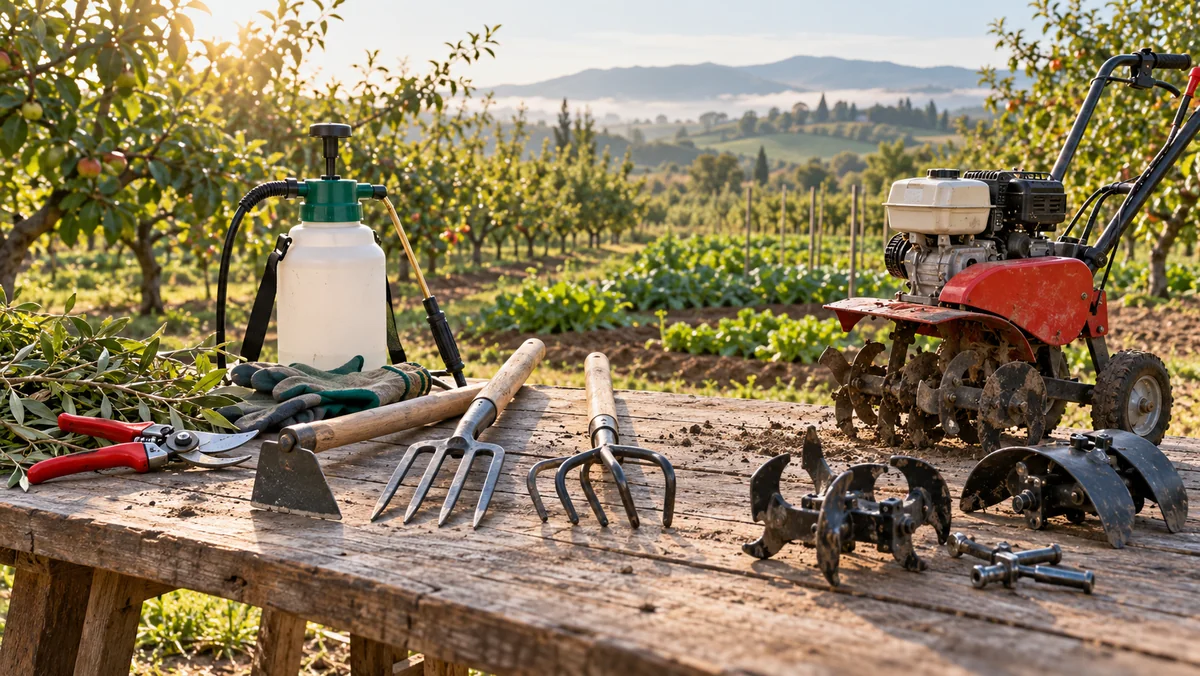
A farm-supply wholesaler in Australia may need secateurs for vineyards, loppers for orchards, transplanting trowels for nurseries and replacement blades for maintenance teams. Those are separate product problems. Comparing offers simply as “garden tools” makes it hard to judge whether a shipment will suit commercial users or remain saleable between seasonal orders. This guide concentrates on hand-operated cultivation and pruning tools, not powered machinery.
Start with the farm task and the user
For orchard pruning, ask whether the target tool is bypass or anvil-action, its declared cutting capacity, spring and lock design, grip size and availability of service parts. For nurseries, trowels and weeders require suitable shank strength, handle attachment, corrosion protection and packing dimensions. A vineyard contractor may value blade replacement and cleaning access more than decorative finish. The best mix for a hardware retailer is not necessarily the right mix for an intensive commercial grower.
Australian horticultural wholesalers already describe their ranges by cultivation, planting, harvesting and pruning. Ryset's Australian range is a useful observation of local trade terminology; it is not evidence of search volume or a supplier endorsement. A wholesale sourcing brief should identify the actual farm segment and distribution channel.
Specify materials and tool performance before the price
Ask each prospective manufacturer to identify blade alloy and heat-treatment process, cutting edge geometry, blade thickness, hardness test method where claimed and realistic sharpening/replacement arrangements. For wooden, polymer or composite handles, specify grip construction, weight, finish and secure joining. Request drawings or dimensioned product sheets for large-volume repeat orders.
Do not accept “stainless”, “high carbon” or “professional quality” without model-specific information. A tool can look well finished yet have an uncomfortable spring force or a locking mechanism that fails after repetitive use. For an initial test, compare sample tools under a documented task and record usability, cut quality, blade alignment, grip comfort and wear. Performance claims should be tied to the exact variant tested.
Plan wholesale cartons and seasonal supply
Ask for units per inner pack and master carton; net and gross weights; carton dimensions; replacement spring and blade SKU; spare-parts compatibility; instruction and warning label languages; and the smallest practical production run. For private label, separate the packaging-artwork lead time from manufacturing lead time and obtain approval samples before releasing a full production lot.
Set a clear definition of a defect and establish who pays for rejected or damaged items. A distributor serving vineyard and orchard customers should ask whether spare blades can be reordered independently; otherwise a low initial unit price may increase later warranty and service costs.
Australia-bound shipment and biosecurity considerations
Australia's Department of Agriculture, Fisheries and Forestry (DAFF) requires imported goods to meet applicable biosecurity conditions. DAFF guidance highlights soil, seeds and plant or animal matter on imported machinery, equipment and spare parts. For a consignment of unused hand tools, insist on clean manufacture, covered storage and dry, contamination-free packing. The exact biosecurity treatment of a hand tool, a wood handle or a used tool must be checked for the particular goods and their materials, rather than assuming that DAFF rules for field-tested machinery automatically cover every secateur.
Before ordering, the Australian importer or broker should check commodity-specific requirements in BICON, including whether a permit, inspection or other import condition applies. If the tools have wooden handles or wooden packaging, check relevant material and packaging obligations separately. An invoice statement that the goods are new is not a substitute for a correct goods assessment.
The Australian Border Force explains that imported commercial goods may attract customs duty and GST depending on classification and available exemptions. Its official GST guidance states that GST is generally 10% of the value of a taxable importation; this is not a quote for your particular tool shipment. Ask the broker to verify the appropriate tariff heading and landed cost using the final SKU specifications, values and shipping terms.
Quote request example for a TURKIYE supplier
Request 300 bypass secateurs and 300 hand trowels as separate lines only if those quantities match actual demand; the figures are example ordering quantities, not market demand data. For each SKU provide a technical drawing or sample reference, material specification, tool and grip dimensions, carton quantities, replacement-part references, product photos, branding needs and delivery destination in Australia. Ask for a sample invoice and product-level test evidence before negotiating price.
Compare quotations with the same Incoterms® rule and named place or port, including inspection, packaging, freight allowance and replacement-parts plan. Use the Australia sourcing hub to submit a clear product brief. Supplier capabilities, certifications and delivery commitments should be verified for the specific order.
Before you place an order
- Confirm the intended task, sample acceptance criteria and exact SKU specification.
- Agree carton quantities, spare parts, lead times and defect handling.
- Ask the importer or broker to check current BICON conditions for the tools, handles and packaging before dispatch.
- Compare the complete landed cost, not just the unit price.
This is a buying checklist, not a product-specific import clearance or tax determination. Sources checked on 6 November 2026.